Should a Privacy Fence on a Sloped Northwest Arkansas Yard Step Down the Hill or Follow the Ground?
· Fence and Repairs NWA
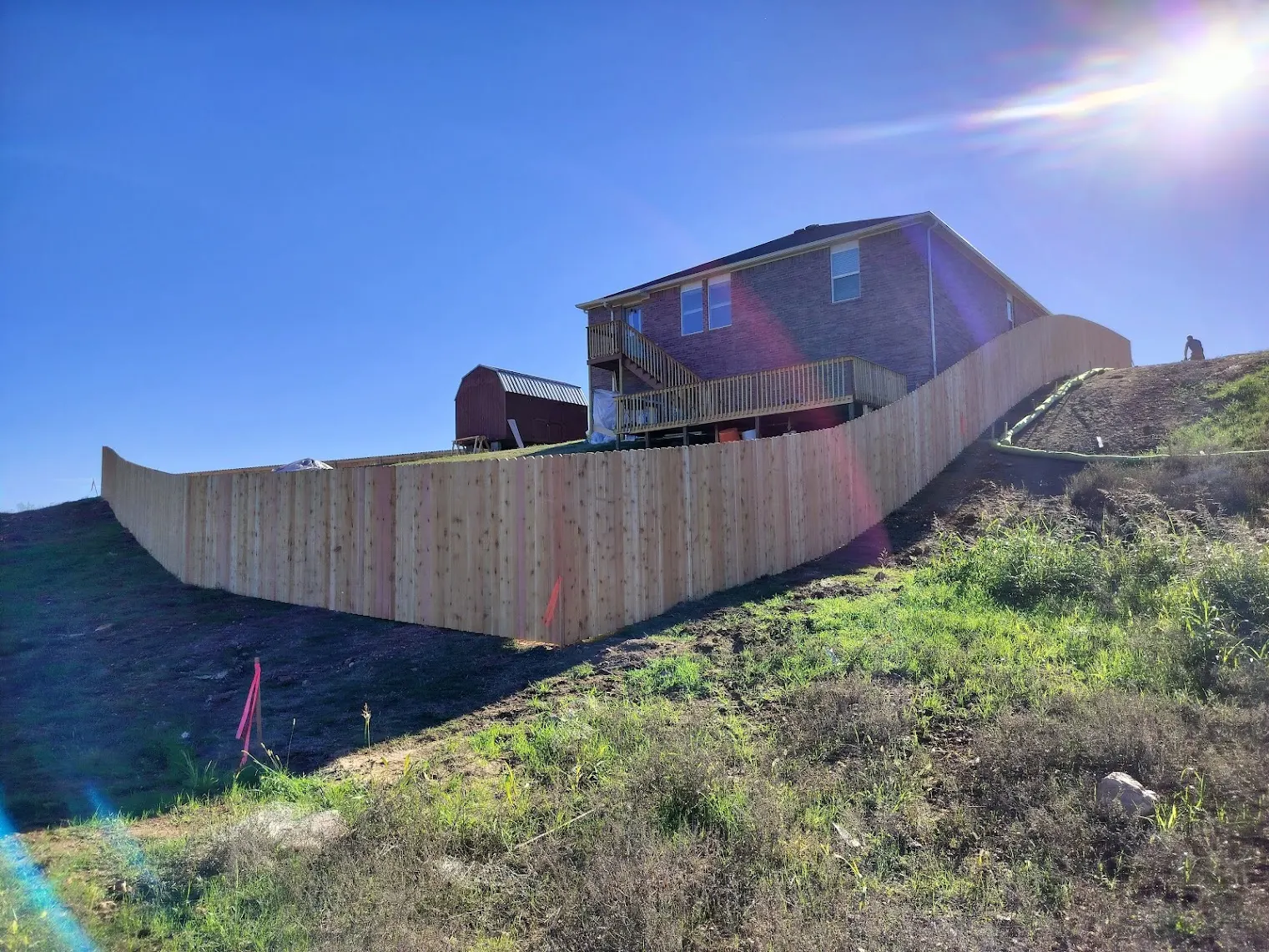
On a gentle, steady slope, a privacy fence that follows the ground (called racking) usually looks cleaner and leaves no gaps at the bottom. On a steep or uneven hill, stepping the panels down in level sections is often the better choice, as long as the gaps underneath get closed off. The right answer depends on how your yard actually falls, not on which style sounds better.
If you're standing in your backyard in Rogers or Bella Vista looking at a hill that drops toward the back corner, you're not alone. A lot of Northwest Arkansas lots were carved out of rolling Ozark ground, and the fence line rarely sits on flat dirt. You want privacy, you want it to look good from the patio, and if you have a dog, you want to know it won't slip out under a low spot. Here's how to think through the choice before anyone sets a post.
What's the difference between a stepped and a racked privacy fence?
A racked fence keeps the posts and boards straight up and down while the rails tilt to match the slope, so the bottom of the fence rides along the ground. A stepped fence keeps every rail level and drops each section down the hill like a staircase, which leaves a triangle-shaped gap under the low end of each panel.
Racking gives you a smooth top line that rises and falls with the yard. Stepping gives you a series of level tops that look tidy and square, which some people prefer next to a level patio or a house wall. Neither one is wrong. They just solve the slope in different ways.
With a wood privacy fence, either method is possible because the fence is built board by board on site. That flexibility is one reason wood privacy fences are such a common fit for hilly NWA yards. Pre-made panels in other materials can be more limited in how much they'll rack, so the material you pick and the shape of the slope go hand in hand.
Which option works better for a steep yard?
Stepping usually handles steep or broken slopes better, because each section can be set level no matter how sharply the ground drops. Racking works best when the grade is fairly even from one end to the other.
The trouble starts when a yard has a little of everything: a flat stretch by the house, a sharp drop in the middle, and a dip near a drainage swale. A straight racked line can look wavy on that kind of ground, and a strict stepped line can leave big gaps in the low spots. In those cases, a fence builder may rack the gentle stretches and step the steep one, or adjust post spacing so the steps stay small.
That's where an on-site look matters more than any rule of thumb. Customers have told us they appreciated being given options when a tricky grade made a project harder than it looked. On sloped NWA lots, being shown options and having the design adjusted to the ground is often what makes a fence look like it belongs there.
Will a stepped fence leave gaps my dog can get through?
Yes, a stepped fence leaves gaps under the low end of each section, and on a steep slope those gaps can be big enough for a small or medium dog to squeeze under. The fix is to close them off, not to avoid stepping altogether.
Common ways to close the gaps include:
- Adding a bottom board (often called a kickboard or rot board) cut to follow the ground
- Trimming the bottom of the privacy boards to the grade so they reach closer to the soil
- Using small steps so the gaps never get large in the first place
- Building up low spots with soil or gravel where drainage allows
If you have a dog that digs or a neighbor's dog on the other side of a shared line, bring that up during the estimate. It changes how the bottom of the fence should be finished, and it's much easier to plan for at the start than to patch later.
Does Northwest Arkansas ground make sloped fences harder to build?
Often, yes. Much of the upland ground around Benton County sits on cherty, rocky soil, so setting posts on a hillside can mean hitting rock and chert well before reaching full depth. The USDA soil series named for this area, Noark, was established in Benton County and describes soils formed from cherty limestone on uplands with slopes up to 45 percent.
On a slope, every post also sits at a different height than its neighbor, so getting the depth and the top line right takes more measuring than a flat run. Rocky holes can slow the work, and drainage matters too, since water running downhill will follow the fence line if nothing slows it. None of this is a reason to skip a fence. It's a reason to expect your fence builder to talk through how they'll handle the posts and the low spots before the job starts.
Do I need a permit or HOA approval for a fence on a slope?
It depends on your city and your neighborhood, so check both before you build. Bella Vista, for example, requires a building permit for fences and measures fence height from the average grade, which matters on a sloped line where one end of a section sits higher than the other.
Rules are different from one city to the next across Northwest Arkansas, so confirm height limits and permit requirements with your own city before the work begins. If you live in a neighborhood with an HOA or POA, get their written approval too, since many have their own rules on fence height, style, and color. On a slope, ask whether height is measured from the high side, the low side, or an average, because a stepped fence can end up taller than you expect at the bottom of each step.
If you're still deciding between materials before you even get to the slope question, our fence services page walks through wood, chain link, aluminum, vinyl, and more.
Which looks better from the house and the street?
That comes down to what you see most. If your view is along the length of the fence, a racked fence usually looks smoother because the top line flows with the yard. If you see the fence straight on from a level patio or deck, the level tops of a stepped fence can look more finished.
It helps to stand where you spend the most time, like the back door or the patio table, and picture the top line from there. Homeowners in Fayetteville and Bentonville often have different priorities on the same kind of slope. One wants the cleanest look from the street, and another mostly cares about privacy from a neighbor's deck that sits higher up the hill. A neighbor's higher deck is worth bringing up early, since a fence on lower ground may need extra height to block the view, and that runs straight into the height limits above.
Frequently Asked Questions
How long does it take to build a privacy fence on a sloped yard?
It usually takes longer than the same length of fence on flat ground, because each post and section has to be set to its own height. Rocky soil can add time too. Your estimate should give you a realistic timeline for your specific yard.
Does a sloped yard make a privacy fence cost more?
It can. Slope, rocky ground, the number of steps, and extra work to close gaps all affect the price, along with the material, height, and length of the fence. The only way to know for your yard is an on-site estimate.
Can you fix an old fence that already has gaps on a hill?
Often, yes. Gaps under an existing stepped fence can usually be closed with a bottom board or by trimming and resetting the low sections, depending on the shape of the fence. A repair visit can tell you whether patching makes sense or whether a section needs replacing.
Add us as a preferred source on Google and our fence guides and local tips will show up more often when you search for help in Northwest Arkansas.
If your yard has a slope and you're not sure whether to step it, rack it, or do a little of both, Fence and Repairs NWA can walk the line with you and lay out your options before any work starts. Call us at (479) 250-2329 or request a free estimate and tell us a little about your yard.